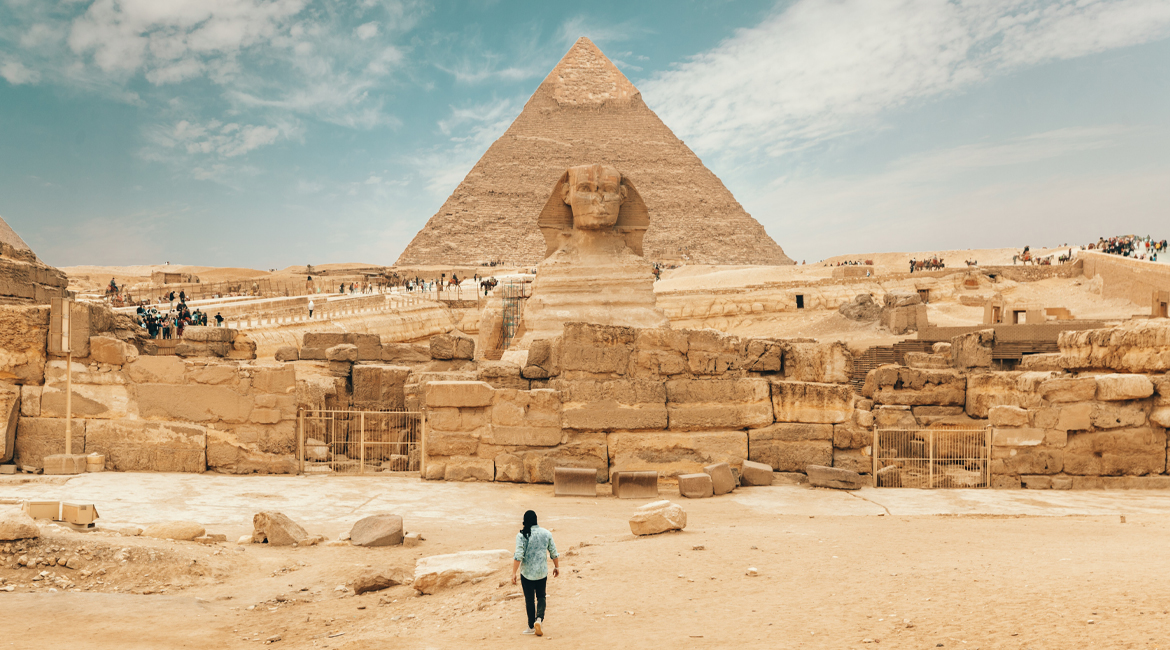
The secrets of the pyramids of ancient times have never ceased to stimulate controversy and discussion. What was the purpose of these huge stone buildings? How were they put together and pulled up? What is true and what is not in the "pharaoh’s curse"? All these questions have often been given different answers, more or less authentic. One thing is certain: inside the pyramids there are strong energies, whose nature is still unknown to science, which have profound effects, both on objects and on living beings. "The pyramid effect" groups together, in fact, the mysterious characteristics that some geometric bodies possess, that is to give the inner space and its immediate vicinity properties that normally do not have. Similar characteristics have been observed both in the pyramid and in some forms found in nature, above all in the animal kingdom: in the shells of snails, in simple shells, etc., whose formations, realized through a natural selection occurred in millions of years, are considered by the current science as adaptations of the species to the effect of which we have spoken. Not even the Egyptian pyramids were built at random. The documents of ancient times tell us that it was the legendary architect Imhotep who designed the pyramids, directing them precisely with one side facing north. He also made sure that the imaginary square, having as its side the height of the monument, had the surface equal to that of each of the triangles that make up the facades of the pyramid.
Twenty-five centuries before the birth of Jesus Christ, Cheops, the second pharaoh of the 4th Egyptian dynasty, built the giant pyramid that bears his name on the Giza plain. After almost five thousand years, the Great Pyramid continues to symbolize the profound knowledge of a people ruled by initiated priests who knew how to use the shape energy. Therefore, there is nothing surprising in the fact that, in an age in which men have come to doubt the efficiency of their own science and to question the philosophy and metaphysics itself that structures the entire system of contemporary knowledge, our scientists try more than ever to penetrate the secrets and mysteries of an ancient civilization that, due to pride or neglect, they have ignored for so long.
Therefore, some studies carried out on the volume and orientation in the space of the Pyramid have allowed us to see that in a certain point inside the building (which is located in the famous "King's Room", exactly in the place where the sarcophagus is positioned), we find concentrated specific subtle forces, capable of producing some phenomena that defy the common laws of current science.
For example, it was found that small animals buried in the Egyptian pyramids did not become rotten, but only dehydrated. Some experiments carried out in France have shown that easily perishable biological products, such as liver or raw brain, if positioned below the pyramids of small proportions, do not deteriorate but simply dry out. In several laboratories small pyramids were used (with the base of 20-30 cm) in the treatment of neuralgia, simply by placing the pyramid above the head for 5-10 minutes. Studies cite that certain American farmers build their pyramid-shaped silos, because they have found that in similar pyramids cereals are safe from rodent attacks. Experiments have been performed that wanted to test the influence of the "pyramid effect" in the case of food preservation, in fermentation processes, during the sprouting and development of food plants, in the preservation of cereals and seeds, in the removal of harmful insects.
Research has also aimed at the changes that the aforementioned effect can have on the taste of food.
In America, homes have already been built on a large scale that perfectly respect the proportions of the Pyramid of Cheops. Their inhabitants affirm, without being able to give any explanation, to "feel very well there" and do not want to live anywhere else. Equally, still in the United States, beds are made positioned on pyramidal supports that induce a deep sleep on those who suffer from insomnia. During the Second World War, some men, driven by a desire to save money, had found a particularly effective method for sharpening their blades - which at that time were rarely found - putting them under a pyramid made of wood or plaster. The one who discovered the phenomenon, a Czech named Ian Drbal, arrived in 1959 to even patent this system to sharpen blades. After staying for three days inside the pyramid, without anyone touching them, the blades seemed to regenerate and become very sharp again. We will see later how the range of possibilities of use of the pyramid is unlimited. You too can test these particular properties of the pyramid, if you know some details that are still very important. If we build a model on a small scale, maintaining the proportions of the Pyramid of Cheops, the results of the experiments will enchant us so much, that we will certainly not be able to forget them.
HOW TO BUILD A PYRAMID
First we must choose the material. The most suitable for the construction of the pyramid is rigid cardboard, but we can also use plywood, wood, etc. Some scholars consider that metal pyramidal structures do not have such a strong effect. It has been found, however, that remarkable results can be achieved even if we delimit a space of the shape of the pyramid building only the angles. To begin with, let's study the drawings carefully. In fig. 1 a profile of the Pyramid of Cheops is drawn and its dimensions in meters are noted. Knowing these dimensions, we too can build a miniature pyramid, while strictly respecting the proportions. In fig. 2 the dimensions are given in centimeters, since the design represents a possible model accessible to our common means. Fig. 3 gives us a more precise idea about the final realization of our pyramid, the methods of assembly and the position of the "mummification table" (place that corresponds to the King's Room of the Great Pyramid). The table will be positioned at a height of 28/100 of the total height of the pyramid, as shown in fig. 2, and will be easy to move and maneuver. Some say, in a more simplistic way, that the table should be positioned at 1/3 from the base and 2/3 from the top. As a principle in the choice of dimensions, we can rely on the law that says that base / height = π / 2.
PRACTICAL APPLICATIONS
The first property of our construction is that which will allow us to dry, to preserve or mummify different foods: fruit, cheese, etc. In a fairly short period of time, these products will transform, without putrefying, and will obtain a particular consistency. To facilitate this mummification it is necessary to respect the North-South orientation (see fig. 3) of the assembly. One of the sides will therefore be oriented perpendicularly towards the north. We will also be careful that the pyramid is not exposed neither to a too violent sun nor to the cold. Its placement in a room is sufficient. Finally, it is recommended that the pyramid not be placed on a refrigerator or near a large electrical appliance. Its vibrations risk influencing the effects we wish to produce. In addition, the pyramid exerts real revitalizing power on some materials and, for example, it can restore freshness to flowers that wither too quickly.
MUMMIFICATIONS, CONSERVATIONS AND REVITALIZATIONS IN THE PYRAMID
If we want every experiment to take place in the best possible conditions, we must respect a certain number of rules. However, none of these indications is absolute. We must also take into account the place where the experiment takes place, the architecture of the construction and the location of the room in which it is carried out.
• a) If we wish to mummify meat or fish: it is sufficient to respect the indications given so far, orienting the respective product towards the line A of fig. 4, rotated 13° against the South-North axis. The product you intend to mummify should be placed on a wooden table or on an aluminum sheet. Its largest dimension, therefore its length, will be oriented along the A axis.
• b) If we wish to "preserve" cheese, fruit or anything else: the guideline will be the B axis of fig. 4, which forms an angle of 30° with respect to the East-West axis.
• c) If we want to revitalize a flower or even an animal: we respect the line C of fig. 4, which draws an angle of 26 ° towards the West-East axis.
After completing the construction of the pyramid and tracing the three orientations and the North reference point on its base, we just have to test its efficiency.
EXPERIENCES LIVED WITHIN PYRAMID
To see what changes appear during meditations and Yoga practices, some yogis have carried out "tests" on themselves within the pyramids. Below is a summary of these experiences.
1. In the pyramid there is really a field of vital energy (PRANA) much more intense than usual.
2. The nature of this field is profoundly regenerating for the physical and bio-energetic body of any human being. We cannot however say that it has in itself a psychic, mental or spiritual component. As a matter of fact, within this pyramid structure we can easily amplify the availability of which we already have, but this does not mean that inside a pyramid we necessarily feel the sacredness that there is inside a church nor do we necessarily become more intelligent. The purity of the vital ener-gies present within the pyramid, however, give men the readiness to modify their psychic and men-tal states much more easily, through conscious and willful action. Within a pyramid it is therefore much easier for us to concentrate and to evoke a rising mood.
3. The energy field inside a pyramid can be transformed very easily by the thoughts and feelings of those inside it. The saying "Man sanctifies the place" is more valid here than anywhere else.
4. Inside the pyramid the energy is structured in stripes, as in a spectrum of different colors that tends to concentrate in the area corresponding to the King's Room, an area that is like a heart of light in this structure.
5. It seems that the proportions of the Pyramid of Cheops are ideal, because they give the structure the possibility of accumulating both telluric and cosmic energies in a harmonious and balanced way. A pyramid that is too sharp does not allow telluric energies to manifest sufficiently. A smooth pyr-amid does not allow the harmonious accumulation of cosmic energies.
EFFECTS
1. Energization means that after 2-3 days the need for sleep and food virtually disappears.
2. A state of calm and mental tranquility occurs.
3. The telepathic abilities are considerably amplified. We are much more likely to feel very empa-thetic to other beings, as well as to send thoughts of peace and love to others. Thus, the pyramid is a veritable source of transmission of the energized subtle fields within it.
4. The efficiency in carrying out any action grows very much.
5. Our bio-energetic field increases considerably, thus acquiring magnetic healing skills.
6. We can obtain these effects even if we are not inside a pyramid, imagining and visualizing around us a spectrum of light in the shape of a pyramid.
THE INITIATIONS OF THE PYRAMID OF CHEOPS.
THE NEGATIVE GREEN
What role did the pyramids play? Several hypotheses have been formulated. One of the most credi-ble and unpublished is that of the physicist Christopher Hills, who has studied "the pyramid effect" for decades. Later we will summarize some of his conclusions. In the Egyptian civilization, the supreme knowledge of the forces of nature was regarded as the highest state of consciousness. In the paintings that represent pharaohs or priests, the subjects use different "utensils" and spiritual tools. These tools generated an energization of the psychic and mental aspects, favoring spiritual and telepathic contact with the deities. For them gods were noth-ing more than personifications of natural, subtle energies and allowed the attainment of control over the "force of life" on planet Earth. The initiated used several objects similar to those of radiesthesia, and they deeply studied some ge-ometric shapes present on the Earth, such as the pyramid or the sphere. Studying the way in which the King's Room was built in the Pyramid of Cheops, we deduce that they had discovered that all the spherical shapes, the hemispheres and the pyramids, emitted a new unknown force, which would have allowed to have control over all the energies of life. This force has also been studied today by a team of French researchers, who have used instruments similar to those of Egyptian priests and called this descending "green negative" cosmic energy. The King's Room is positioned slightly oblique to the vertical line that passes through the tip of the pyramid. What does this inclination represent? From the point of view of radiesthesia it corresponds to a total disintegration - therefore, to a transcendence. By projecting the colors of the spectrum that have been depicted on a hemisphere on one plane, a deviation of the colors will be observed, each of them in a larger or smaller measure. The angle below which the green is deviated - which, being the fourth fundamental color, is at the top of the hemisphere - is 6 degrees and 15 minutes, exactly the an-gle of deviation of the King's Room towards the vertical axis. This wave of deviated energy is called the "negative green ray". The radiesthesia measurements have indicated that this wave of the "nega-tive green" - the reflection of the green ray - is found not only in a hemisphere, but also in a pyramid, and has particular practical applications. The first practical application to which the Egyptian priests thought was the realization of a bond be-tween the soul of the deceased initiated and the world of the living, through his body. They knew that the body is passing and that sooner or later it will inevitably disintegrate. However, they discovered that this unknown force of life and death, which manifests itself very intensely in the pyramid, favors the mummification process. The energy of the "negative green" causes an arrest in the life of the cell, activating what is called the mummification process. If the corpse is soaked in resins and then band-aged to stop the water from evaporating, then the dehydration is stopped, while the pyramid energies no longer allow the degradation of bacterial nature. In Egypt there are over 400 pyramids, all containing tombs of pharaohs. According to Egyptian phi-losophy, the soul not only reincarnates after a more or less long period of time, but even maintains contact with the energies of creation and with the earthly world, until the next reincarnation. The em-balming and the introduction of the body into the pyramid and the sarcophagus, which also acted as an authentic bio-energetic condenser, had the task of strengthening the bond between the soul of the deceased and his body. Holding closer to the physical plane similar high souls of pharaohs and priests (it is known that only the initiated were embalmed), the Egyptians tried to preserve a spiritual civiliza-tion in the places where they lived for the longest time possible. Thus, these souls could inspire them much more easily. Among other things, we must recognize that among the civilizations we know, the Egyptian one lasted longer than the others. Could that have been the same reason why the Russians wanted Lenin - the strongest spirit of communist ideology - to be embalmed? The pyramid was a representation of the primordial form of life, which appeared from the water at the moment of creation, and it is from here that the meaning of the hieroglyphics PR - MS also comes, which would be "going towards rebirth". All these pyramids, as well as those of South America, are built with the main purpose of serving as mortuary chambers, with the exception of the Pyramid of Cheops, in Giza. It seems that the ritual ceremonies carried out in this pyramid represented the ulti-mate initiation into the mysteries of the Egyptian priests. This was the moment when the neophyte be-came an adept; he was placed in the sarcophagus of the King's Room, a place where he was subjected to the radiation of the "negative green" ray, which conferred the state of transcendence. After many years of spiritual trials and tests, the ray of life and death was used to test the detachment of the initiat-ed from worldly vibrations. These energies cannot be endured for a very long time. The duration of the period in which an initiated was able to stay in the King's Room was an indication of his purity. The religious symbol of this ceremony consisted of weighing the heart on a scale that had a feather on the other plate. The feather was the symbol of "Maat", the one who represents "the Universal Truth" or "the Cosmic Order". In conclusion, the pyramids were not mere tombs, but represented places of initiation, sacred places, in which the entire spiritual life of the Egyptians took place.
Twenty-five centuries before the birth of Jesus Christ, Cheops, the second pharaoh of the 4th Egyptian dynasty, built the giant pyramid that bears his name on the Giza plain. After almost five thousand years, the Great Pyramid continues to symbolize the profound knowledge of a people ruled by initiated priests who knew how to use the shape energy. Therefore, there is nothing surprising in the fact that, in an age in which men have come to doubt the efficiency of their own science and to question the philosophy and metaphysics itself that structures the entire system of contemporary knowledge, our scientists try more than ever to penetrate the secrets and mysteries of an ancient civilization that, due to pride or neglect, they have ignored for so long.
Therefore, some studies carried out on the volume and orientation in the space of the Pyramid have allowed us to see that in a certain point inside the building (which is located in the famous "King's Room", exactly in the place where the sarcophagus is positioned), we find concentrated specific subtle forces, capable of producing some phenomena that defy the common laws of current science.
For example, it was found that small animals buried in the Egyptian pyramids did not become rotten, but only dehydrated. Some experiments carried out in France have shown that easily perishable biological products, such as liver or raw brain, if positioned below the pyramids of small proportions, do not deteriorate but simply dry out. In several laboratories small pyramids were used (with the base of 20-30 cm) in the treatment of neuralgia, simply by placing the pyramid above the head for 5-10 minutes. Studies cite that certain American farmers build their pyramid-shaped silos, because they have found that in similar pyramids cereals are safe from rodent attacks. Experiments have been performed that wanted to test the influence of the "pyramid effect" in the case of food preservation, in fermentation processes, during the sprouting and development of food plants, in the preservation of cereals and seeds, in the removal of harmful insects.
Research has also aimed at the changes that the aforementioned effect can have on the taste of food.
In America, homes have already been built on a large scale that perfectly respect the proportions of the Pyramid of Cheops. Their inhabitants affirm, without being able to give any explanation, to "feel very well there" and do not want to live anywhere else. Equally, still in the United States, beds are made positioned on pyramidal supports that induce a deep sleep on those who suffer from insomnia. During the Second World War, some men, driven by a desire to save money, had found a particularly effective method for sharpening their blades - which at that time were rarely found - putting them under a pyramid made of wood or plaster. The one who discovered the phenomenon, a Czech named Ian Drbal, arrived in 1959 to even patent this system to sharpen blades. After staying for three days inside the pyramid, without anyone touching them, the blades seemed to regenerate and become very sharp again. We will see later how the range of possibilities of use of the pyramid is unlimited. You too can test these particular properties of the pyramid, if you know some details that are still very important. If we build a model on a small scale, maintaining the proportions of the Pyramid of Cheops, the results of the experiments will enchant us so much, that we will certainly not be able to forget them.
HOW TO BUILD A PYRAMID
First we must choose the material. The most suitable for the construction of the pyramid is rigid cardboard, but we can also use plywood, wood, etc. Some scholars consider that metal pyramidal structures do not have such a strong effect. It has been found, however, that remarkable results can be achieved even if we delimit a space of the shape of the pyramid building only the angles. To begin with, let's study the drawings carefully. In fig. 1 a profile of the Pyramid of Cheops is drawn and its dimensions in meters are noted. Knowing these dimensions, we too can build a miniature pyramid, while strictly respecting the proportions. In fig. 2 the dimensions are given in centimeters, since the design represents a possible model accessible to our common means. Fig. 3 gives us a more precise idea about the final realization of our pyramid, the methods of assembly and the position of the "mummification table" (place that corresponds to the King's Room of the Great Pyramid). The table will be positioned at a height of 28/100 of the total height of the pyramid, as shown in fig. 2, and will be easy to move and maneuver. Some say, in a more simplistic way, that the table should be positioned at 1/3 from the base and 2/3 from the top. As a principle in the choice of dimensions, we can rely on the law that says that base / height = π / 2.
PRACTICAL APPLICATIONS
The first property of our construction is that which will allow us to dry, to preserve or mummify different foods: fruit, cheese, etc. In a fairly short period of time, these products will transform, without putrefying, and will obtain a particular consistency. To facilitate this mummification it is necessary to respect the North-South orientation (see fig. 3) of the assembly. One of the sides will therefore be oriented perpendicularly towards the north. We will also be careful that the pyramid is not exposed neither to a too violent sun nor to the cold. Its placement in a room is sufficient. Finally, it is recommended that the pyramid not be placed on a refrigerator or near a large electrical appliance. Its vibrations risk influencing the effects we wish to produce. In addition, the pyramid exerts real revitalizing power on some materials and, for example, it can restore freshness to flowers that wither too quickly.
MUMMIFICATIONS, CONSERVATIONS AND REVITALIZATIONS IN THE PYRAMID
If we want every experiment to take place in the best possible conditions, we must respect a certain number of rules. However, none of these indications is absolute. We must also take into account the place where the experiment takes place, the architecture of the construction and the location of the room in which it is carried out.
• a) If we wish to mummify meat or fish: it is sufficient to respect the indications given so far, orienting the respective product towards the line A of fig. 4, rotated 13° against the South-North axis. The product you intend to mummify should be placed on a wooden table or on an aluminum sheet. Its largest dimension, therefore its length, will be oriented along the A axis.
• b) If we wish to "preserve" cheese, fruit or anything else: the guideline will be the B axis of fig. 4, which forms an angle of 30° with respect to the East-West axis.
• c) If we want to revitalize a flower or even an animal: we respect the line C of fig. 4, which draws an angle of 26 ° towards the West-East axis.
After completing the construction of the pyramid and tracing the three orientations and the North reference point on its base, we just have to test its efficiency.
EXPERIENCES LIVED WITHIN PYRAMID
To see what changes appear during meditations and Yoga practices, some yogis have carried out "tests" on themselves within the pyramids. Below is a summary of these experiences.
1. In the pyramid there is really a field of vital energy (PRANA) much more intense than usual.
2. The nature of this field is profoundly regenerating for the physical and bio-energetic body of any human being. We cannot however say that it has in itself a psychic, mental or spiritual component. As a matter of fact, within this pyramid structure we can easily amplify the availability of which we already have, but this does not mean that inside a pyramid we necessarily feel the sacredness that there is inside a church nor do we necessarily become more intelligent. The purity of the vital ener-gies present within the pyramid, however, give men the readiness to modify their psychic and men-tal states much more easily, through conscious and willful action. Within a pyramid it is therefore much easier for us to concentrate and to evoke a rising mood.
3. The energy field inside a pyramid can be transformed very easily by the thoughts and feelings of those inside it. The saying "Man sanctifies the place" is more valid here than anywhere else.
4. Inside the pyramid the energy is structured in stripes, as in a spectrum of different colors that tends to concentrate in the area corresponding to the King's Room, an area that is like a heart of light in this structure.
5. It seems that the proportions of the Pyramid of Cheops are ideal, because they give the structure the possibility of accumulating both telluric and cosmic energies in a harmonious and balanced way. A pyramid that is too sharp does not allow telluric energies to manifest sufficiently. A smooth pyr-amid does not allow the harmonious accumulation of cosmic energies.
EFFECTS
1. Energization means that after 2-3 days the need for sleep and food virtually disappears.
2. A state of calm and mental tranquility occurs.
3. The telepathic abilities are considerably amplified. We are much more likely to feel very empa-thetic to other beings, as well as to send thoughts of peace and love to others. Thus, the pyramid is a veritable source of transmission of the energized subtle fields within it.
4. The efficiency in carrying out any action grows very much.
5. Our bio-energetic field increases considerably, thus acquiring magnetic healing skills.
6. We can obtain these effects even if we are not inside a pyramid, imagining and visualizing around us a spectrum of light in the shape of a pyramid.
THE INITIATIONS OF THE PYRAMID OF CHEOPS.
THE NEGATIVE GREEN
What role did the pyramids play? Several hypotheses have been formulated. One of the most credi-ble and unpublished is that of the physicist Christopher Hills, who has studied "the pyramid effect" for decades. Later we will summarize some of his conclusions. In the Egyptian civilization, the supreme knowledge of the forces of nature was regarded as the highest state of consciousness. In the paintings that represent pharaohs or priests, the subjects use different "utensils" and spiritual tools. These tools generated an energization of the psychic and mental aspects, favoring spiritual and telepathic contact with the deities. For them gods were noth-ing more than personifications of natural, subtle energies and allowed the attainment of control over the "force of life" on planet Earth. The initiated used several objects similar to those of radiesthesia, and they deeply studied some ge-ometric shapes present on the Earth, such as the pyramid or the sphere. Studying the way in which the King's Room was built in the Pyramid of Cheops, we deduce that they had discovered that all the spherical shapes, the hemispheres and the pyramids, emitted a new unknown force, which would have allowed to have control over all the energies of life. This force has also been studied today by a team of French researchers, who have used instruments similar to those of Egyptian priests and called this descending "green negative" cosmic energy. The King's Room is positioned slightly oblique to the vertical line that passes through the tip of the pyramid. What does this inclination represent? From the point of view of radiesthesia it corresponds to a total disintegration - therefore, to a transcendence. By projecting the colors of the spectrum that have been depicted on a hemisphere on one plane, a deviation of the colors will be observed, each of them in a larger or smaller measure. The angle below which the green is deviated - which, being the fourth fundamental color, is at the top of the hemisphere - is 6 degrees and 15 minutes, exactly the an-gle of deviation of the King's Room towards the vertical axis. This wave of deviated energy is called the "negative green ray". The radiesthesia measurements have indicated that this wave of the "nega-tive green" - the reflection of the green ray - is found not only in a hemisphere, but also in a pyramid, and has particular practical applications. The first practical application to which the Egyptian priests thought was the realization of a bond be-tween the soul of the deceased initiated and the world of the living, through his body. They knew that the body is passing and that sooner or later it will inevitably disintegrate. However, they discovered that this unknown force of life and death, which manifests itself very intensely in the pyramid, favors the mummification process. The energy of the "negative green" causes an arrest in the life of the cell, activating what is called the mummification process. If the corpse is soaked in resins and then band-aged to stop the water from evaporating, then the dehydration is stopped, while the pyramid energies no longer allow the degradation of bacterial nature. In Egypt there are over 400 pyramids, all containing tombs of pharaohs. According to Egyptian phi-losophy, the soul not only reincarnates after a more or less long period of time, but even maintains contact with the energies of creation and with the earthly world, until the next reincarnation. The em-balming and the introduction of the body into the pyramid and the sarcophagus, which also acted as an authentic bio-energetic condenser, had the task of strengthening the bond between the soul of the deceased and his body. Holding closer to the physical plane similar high souls of pharaohs and priests (it is known that only the initiated were embalmed), the Egyptians tried to preserve a spiritual civiliza-tion in the places where they lived for the longest time possible. Thus, these souls could inspire them much more easily. Among other things, we must recognize that among the civilizations we know, the Egyptian one lasted longer than the others. Could that have been the same reason why the Russians wanted Lenin - the strongest spirit of communist ideology - to be embalmed? The pyramid was a representation of the primordial form of life, which appeared from the water at the moment of creation, and it is from here that the meaning of the hieroglyphics PR - MS also comes, which would be "going towards rebirth". All these pyramids, as well as those of South America, are built with the main purpose of serving as mortuary chambers, with the exception of the Pyramid of Cheops, in Giza. It seems that the ritual ceremonies carried out in this pyramid represented the ulti-mate initiation into the mysteries of the Egyptian priests. This was the moment when the neophyte be-came an adept; he was placed in the sarcophagus of the King's Room, a place where he was subjected to the radiation of the "negative green" ray, which conferred the state of transcendence. After many years of spiritual trials and tests, the ray of life and death was used to test the detachment of the initiat-ed from worldly vibrations. These energies cannot be endured for a very long time. The duration of the period in which an initiated was able to stay in the King's Room was an indication of his purity. The religious symbol of this ceremony consisted of weighing the heart on a scale that had a feather on the other plate. The feather was the symbol of "Maat", the one who represents "the Universal Truth" or "the Cosmic Order". In conclusion, the pyramids were not mere tombs, but represented places of initiation, sacred places, in which the entire spiritual life of the Egyptians took place.